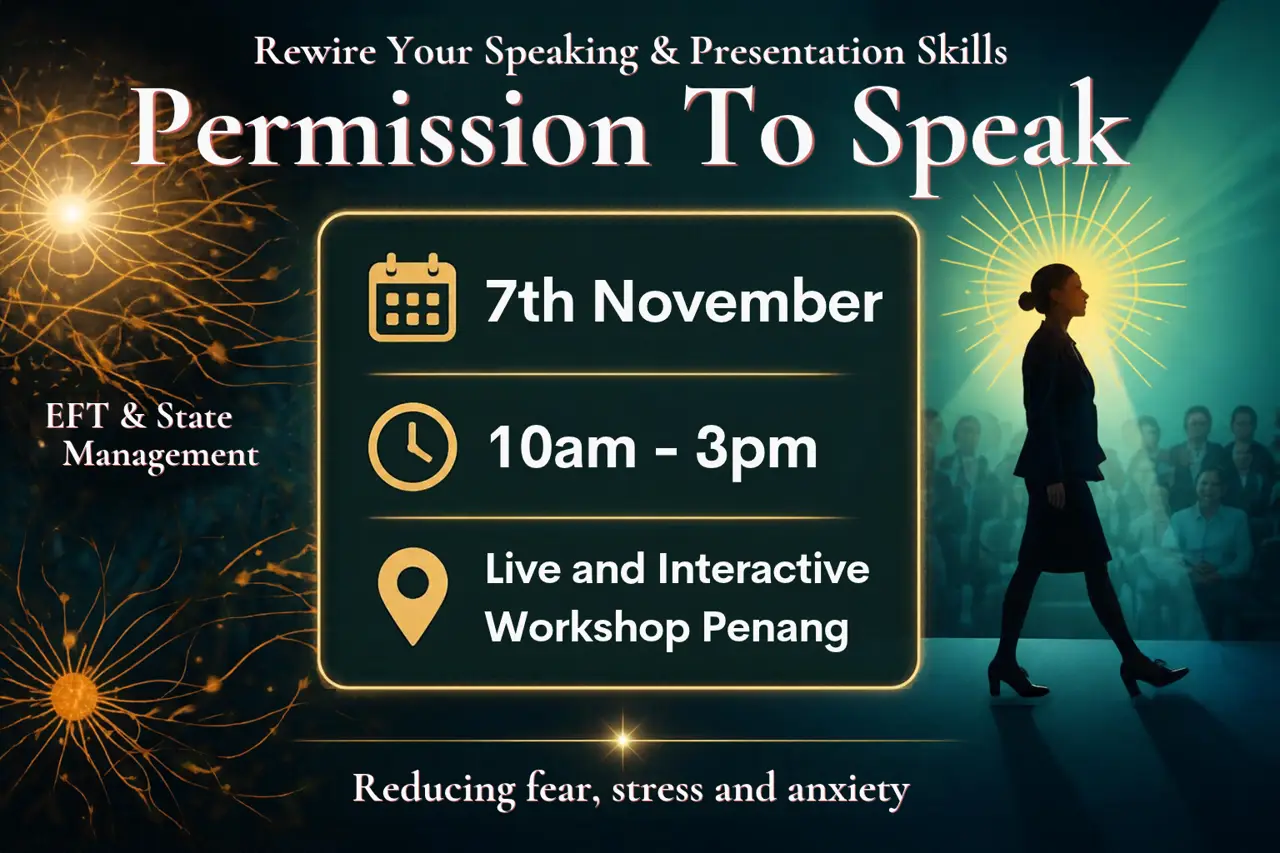
Permission to Speak Without Fear and Anxiety
Course 2 of the Rewiring Your Speaking & Presentation Skills program. A live 4-hour workshop for coaches, trainers and career-changers who are ready to stop pushing through fear and start managing the state it comes from.
You’re in. Here is what you are walking into.
You know your material. You’ve prepared. Then the moment arrives and your mind goes blank, or you rush, or you over-explain, or you smile too much and agree to things you don’t mean.
That is not a talent problem or a character flaw. It is a state problem, and states can be learned, mapped and managed.
On 7 November you get a method, a map of your inner territory, and a first practice you can start using the next morning.
Where this fits: Course 2 of the program
Rewiring Your Speaking & Presentation Skills is a progression, not a set of stand-alone events.
Your place in the room builds the base for everything after it.
Who this is for
This is for you if:
- You are a coach or trainer who wants a foundation to build your own client programmes on
- You are in a second career, where being visible is suddenly part of the job
- You are an aspiring thought leader, author or presenter who wants to be seen without bracing for it
- You lose composure when challenged, put on the spot, or asked about money
- You feel stuck in earning more, and you are ready to work on the state underneath the actions
- You want a current, non-clinical approach that quiets the mind and improves nervous system regulation, the effects many people seek from meditation
- You want to understand the basics of helping others who deal with fear, anxiety and dysregulation from hidden stress
- You want to progress to future programs on money, confidence and self-actualisation
- You want the full Clarity Awareness Framework, to structure your potential as a leader, coach or trainer and develop your own signature programs
This is not for you if you want:
- A clinical treatment or therapy
- A certification to teach EFT
- A motivational event with nothing to practise
- To start making money overnight
The problem, named mechanically
Your performance on stage was decided long before you stepped onto it. What you did all week, how loaded your nervous system already was, and how much attention was left over set the bandwidth you actually have in the room.
When that bandwidth runs short, the nervous system takes over with one of four automatic responses. Which one is yours?
Most people have a default. Naming yours is the first step to changing it.
What is state management?
State management is the skill of noticing what state your nervous system is in, choosing how to respond, and returning to a settled baseline faster.
It has three parts:
It also has a daily side. Mental, emotional and nervous system hygiene, practised regularly, builds spare bandwidth before the high-stakes day arrives. You don’t earn calm on the day. You bank it before.
Where else this shows up in life:
- Hard conversations at work or at home, where you want to stay present instead of reacting
- Negotiation and sales, where pushback triggers fight or fawn
- Interviews, reviews and exams, where freeze costs you what you know
- Parenting and caregiving, where a settled adult sets the tone for the room
- Coaching and teaching others, where you can only guide someone to a state you can hold yourself
A settled presence tends to settle the people around it. That is why this skill matters beyond your own performance.
What is EFT?
EFT stands for Emotional Freedom Techniques, often called tapping. You tap with your fingertips on specific points on the face and upper body while you bring a stressor to mind. In this workshop it is one of the tools you use to bring your state down so you can think and act.
What the research says:
How we use it: as a skill for state regulation and composure. It isn’t a replacement for medical or psychological care, and we don’t claim it cures anything. You learn it as a practical tool, then decide how it fits your life.
The deeper layer: state, being seen, and money
This is the part most speaking courses never touch.
Money worry takes attention. In a 2013 study published in Science, prompting people who were financially stretched to think about money problems lowered their performance on cognitive tasks. The researchers’ explanation is that financial worry consumes mental bandwidth, leaving less for everything else. It is the same bandwidth you need to speak.
Earning often depends on being seen. Pitching, pricing, publishing, asking, following up and saying yes or no all require visibility. That is where the 4F responses show up around money:
Self-doubt makes this worse. Higher levels were linked to a greater chance of receiving no outside funding.
What we do about it: you learn to spot which response fires in your own money and visibility moments, regulate it, and take the action anyway. The next course, Hidden Resistance, goes deeper into these blocks.
What changes after
In the room, you will:
- Recognise your 4F pattern as it happens
- Understand how stress and inner self-talk patterns show up, and how to turn down the noise
- Explore hidden identity-level beliefs and begin to rewire them
- Learn a tool to bring your state down in a few minutes, and to act despite hesitation without relying on motivation or positive thinking
In the weeks after, you may find yourself:
Your day
Saturday 7 November 2026 · 10:00am to 3:00pm
Bangunan Lip Sin, Sungai Dua, Gelugor 11700, Penang

Your bonus: The structure of a presentation
Staying composed is half of it. The other half is knowing what you are standing up to say, and why.
Have you been asked to present, train or lead a meeting without knowing what you are supposed to say?
Do you sit in front of a blank document or slide deck and go blank for a long time?
Do you rehash existing documents into slides just to get the job done?
Have you stood in front of a room or clients and felt people were there only because they had to be?
Slides existing is not the job done.
The presentation is the product. Building one is product development: you take what you already know and shape it into something you can articulate, deliver and take to market.
Three ideas you take away:
- Know your audience, and cater the presentation to them.
- Know the difference between intent and purpose, and how that difference changes what you include and in what order.
- Turn fuzzy ideas into a clean, coherent arc you can deliver.
Why this matters:
Every presentation and sales conversation is a marketing job, so the work begins before the first slide. When you have already externalised what lives in your head, the presentation itself is the easy part. The same method adapts across the full spectrum of presentations, and you don’t need a product or marketing background to use it.
It is especially valuable if you aspire to be a thought leader, author, key accounts or business development head, presenter or trainer.
About your facilitator

Lovinia Mak is a Malaysian learning design specialist, corporate trainer and professional coach based in Penang. She has been building her training and coaching practice since 2011, and is the Principal Trainer and Founder of Clarity Awareness Cognitive Architecture Systems, an organisation focused on human-centric soft skills, learning design and cognitive development. She created the Clarity Awareness Framework you learn in this program.
14 / BEFORE THE DAYBefore the day
Arrive by: 9:45am
Bring: paper, pen, snacks
Optional prep (five minutes): this week, notice which of the four responses shows up first when you’re put on the spot. Just notice. Don’t fix it.
15 / FAQFAQ
What is EFT?
Emotional Freedom Techniques, also called tapping. You use it here as a state-regulation tool.
Is this therapy?
No. It is a skills workshop. It doesn’t replace medical or psychological care.
Will I be qualified to teach EFT afterwards?
No. You leave with a foundation for self-practice, a method and a path to help others.
I’m not a public speaker. Is this for me?
Yes, if you’ve ever lost composure under pressure or avoided being seen.
I’m already a coach. What’s in it for me?
A map of inner states and a diagnostic lens you can build your own programmes on.
Does it promise more income?
No. It works on the state that sits underneath the actions income depends on.